Private 5G is a dedicated cellular network built and operated for a single organization, rather than shared across the public with millions of consumer subscribers. It uses licensed, shared, or unlicensed spectrum — such as CBRS in the United States — to deliver wireless coverage engineered specifically for one facility, campus, or industrial site. Unlike Wi-Fi, which was designed for best-effort connectivity, private 5G is built for guaranteed performance: predictable latency, dedicated bandwidth per device, and coverage that reaches into steel-and-concrete environments where Wi-Fi signals typically degrade.
The market data explains why this has become a 2026 boardroom topic rather than a lab experiment. The global private 5G network market is projected to grow from roughly USD 5.9 billion in 2026 toward more than USD 150 billion by 2033, at a compound annual growth rate near 59%. Deployments have shifted from vendor-sponsored pilots to organic enterprise demand, with an estimated 6,500 private LTE/5G networks now live worldwide across manufacturing, logistics, healthcare, utilities, mining, and ports.
For enterprises running IoT sensors, automated guided vehicles, robotics, or real-time video analytics, the question in 2026 is no longer "should we consider private 5G?" but "where does it fit into our existing connectivity stack?" That is where most projects stall — not because the technology fails, but because IT teams try to bolt a cellular network onto an architecture that was never designed to carry it. A private 5G deployment only delivers on its promise when it is engineered as part of a broader multi-operator connectivity strategy that ties wireless, fiber, and SD-WAN together under one managed architecture.
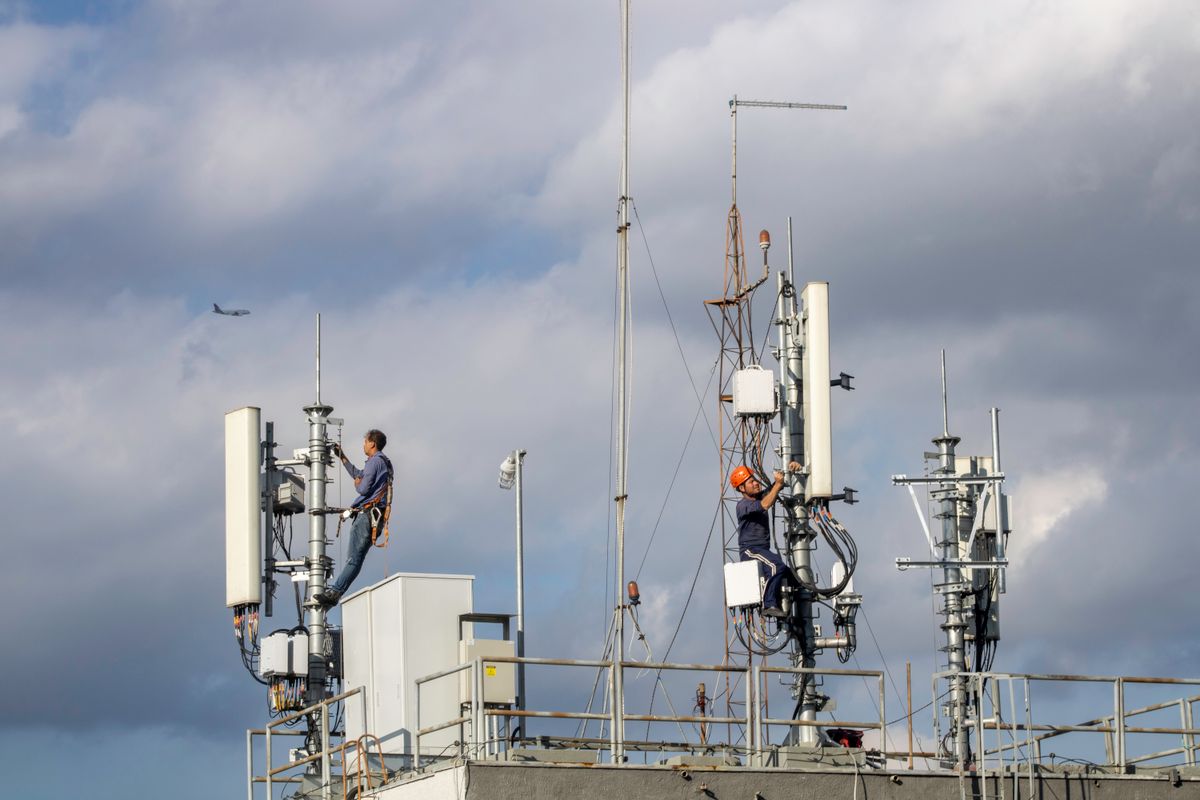

Most enterprises don't evaluate private 5G because they're chasing new technology for its own sake — they evaluate it because Wi-Fi and public cellular have hit a wall. Wi-Fi operates on unlicensed spectrum shared with every other device in range, which means dense industrial environments see interference, dropped connections, and coverage dead zones behind machinery, in warehouses with high metal racking, or across sprawling outdoor yards and ports. Public 4G/5G, meanwhile, offers wide coverage but no guaranteed capacity: during peak demand, an enterprise's mission-critical traffic competes with every consumer smartphone on the same tower.
Neither gap is cosmetic. When a manufacturing line depends on wireless connectivity for real-time quality-control cameras or robotic coordination, a dropped Wi-Fi packet can halt production. When a logistics yard tracks thousands of containers with IoT sensors, an unreliable public network means blind spots in inventory visibility. And from a security standpoint, consumer-grade Wi-Fi and public cellular both expand the attack surface: traffic isn't isolated, device authentication is inconsistent, and IT teams often lack visibility into what's actually connecting to the network.
This is fundamentally a network security and architecture problem, not just a coverage problem. Enterprises moving to private 5G typically pair the rollout with a review of how traffic is segmented, authenticated, and monitored — the same discipline HIT applies through its managed cybersecurity services, including SOC monitoring and zero-trust network access, so that a new wireless layer doesn't become a new blind spot.

A private 5G deployment has four core components working together. First, small cells (radio units) are installed throughout the facility, sized and positioned based on a radio-frequency survey of the physical environment — factory floor, warehouse, port, or campus. Second, a 5G core network processes and routes traffic; this can run on-premises for the lowest possible latency and maximum data sovereignty, or in the cloud for lower upfront cost and easier scaling across multiple sites. Third, devices connect via SIM cards or eSIM profiles — everything from ruggedized tablets and forklifts to IoT sensors and autonomous robots — each authenticated individually rather than sharing a single Wi-Fi password. Fourth, and most often overlooked, the private 5G network needs to connect back to the rest of the enterprise WAN, cloud applications, and data center.
That fourth step is where projects succeed or stall. A private 5G network is only as good as the backhaul carrying its traffic to core business systems. Enterprises with multiple sites — a common footprint across Latin America, the US, and Europe — need consistent policy, QoS, and failover between locations, which means the private 5G layer has to be designed alongside SD-WAN and dedicated internet, not as a separate silo IT manages independently. Spectrum access itself is also evolving: 3GPP Release 18's narrowband support is lowering the entry barrier so enterprises no longer need to secure wide spectrum allocations to make a deployment viable, which is accelerating adoption among mid-market organizations that previously assumed private 5G was out of reach.
The single most cited data point in 2026 deployment research is stark: 87% of enterprises report achieving ROI within 12 months of deploying private 5G, a dramatically faster payback than the multi-year timelines associated with earlier private network rollouts. That shift is driven by lower equipment costs, more flexible spectrum options, and vendors packaging private 5G as a managed service rather than a capital-intensive build.
Beyond payback speed, the benefits enterprises report most consistently include deterministic low latency for automation and robotics (critical for use cases where a delay of even tens of milliseconds affects safety or throughput), guaranteed bandwidth per device so mission-critical traffic never competes with guest or consumer usage, coverage that reliably penetrates large industrial structures where Wi-Fi cannot, and network-level traffic isolation that keeps operational technology (OT) separated from IT systems — a security benefit that also simplifies compliance in regulated industries. Manufacturing, logistics, ports, mining, and healthcare campuses are the clearest early adopters, but any enterprise running dense IoT deployments or requiring wall-to-wall wireless reliability across a large physical footprint is now a realistic candidate.
Realizing these benefits at scale, however, depends on integrating private 5G with the rest of the IT environment — device management, monitoring, patching, and helpdesk support — rather than treating it as a standalone project. That's the role of managed IT services: keeping a private wireless network, and everything connected to it, operating reliably long after the installation crew leaves.

HIT Communications has spent more than 30 years building and managing enterprise connectivity across Latin America, the United States, and Europe — the same multi-region footprint where private 5G adoption is now accelerating. We don't sell private 5G as an isolated product; we design it as part of the connectivity architecture our clients already depend on, integrating dedicated internet, SD-WAN, and multi-operator connectivity so a new wireless layer strengthens the network instead of fragmenting it.
That means a private 5G rollout with HIT starts with the same rigor we apply to every connectivity engagement: a site survey to understand coverage requirements, a backhaul design that guarantees the wireless layer has the bandwidth and failover it needs, and a security architecture — built on our managed cybersecurity capabilities — that segments OT and IoT traffic from day one rather than retrofitting it after an incident. For clients running distributed operations across multiple countries, we manage the private 5G deployment as one component of a single, monitored, multi-site network rather than a collection of disconnected local projects.
Private 5G has moved past the pilot phase. With enterprise-grade equipment now more affordable, spectrum access more flexible, and a documented 87% ROI rate within 12 months, 2026 is the year private wireless stops being an experiment for large industrials and starts becoming a standard part of enterprise connectivity planning — provided it's built on the right foundation.
The organizations getting the most from private 5G are the ones treating it as one layer of a broader connectivity and security strategy, not a standalone wireless project. If your facilities are hitting the limits of Wi-Fi, your teams need wall-to-wall coverage for IoT and automation, or you simply want to understand whether private 5G fits your environment, talk to HIT Communications about a connectivity assessment tailored to your sites.

Find out how we can transform your business. Talk to one of our experts now!
Get in touch